
3 steps to follow when affirmations feel like empty words (for stressed parents).
Discover how mindfulness can help you unlock self-kindness and finally believe the words you say.

I know how it feels to stand in front of the mirror, repeat the words ‘I’m doing the best I can’ and still feel like you are falling short. It feels like empty words when you are feeling so stressed and overwhelmed as a parent. An affirmation is like putting the cart before the horse when the self-critical voice is so loud.
Actually, there is an alternative to rhyming off words and feeling nothing. It’s called mindfulness. Even more confused now? Don’t worry you are about to get the breakdown of what mindfulness and affirmations have to do with each other and how to truly believe the words that you say.
As a parent of an anxious child I was really struggling to cope. I felt I wasn’t good enough, I was failing, I was comparing myself to others, ‘how come I couldn’t cope the way that other mums do’. I felt like there was something wrong with me.
As parents life throws us challenges and struggles and it can be a heavy load to carry.
Mindfulness was the game changer for me. I found a new way to relate to my harsh critical voice and from this place I could allow the words in. Words that would support me through the stress and overwhelm that I was experiencing as a parent.
Please read on to find out how you can move to a place too where you can truly believe the words.You need to rewind and go a few steps back before you can truly believe the words and use affirmations to support you. Here are the steps.

1. Bring Mindful awareness to the self-critical voice, allowing it to come to the surface and tuning into what it says.
What does your self-critical voice say? Note down on your piece of paper any words or phrases that come back to you.
What does it feel like in your body when you are critical of yourself? You often will experience this as a tightening in the body or a clenching in the gut.
If you spoke to another person the way that you spoke to yourself how would they react?
Do you often compare yourself to others?
It can also be really helpful to draw out your inner critic.I remember doing this exercise a few years ago and the picture that I drew resembled a monster with clenched teeth and I could hear it roaring to me ‘You are not good enough’.
The exercise is not about turning on ourselves. The self-critical voice takes up so much space both physically and mentally that it needs to be let out. It is powerful to reflect and become aware of the space that it is taking up. This is Mindfulness in action, it is acknowledging that the critical voice exists for us and it is often very loud.
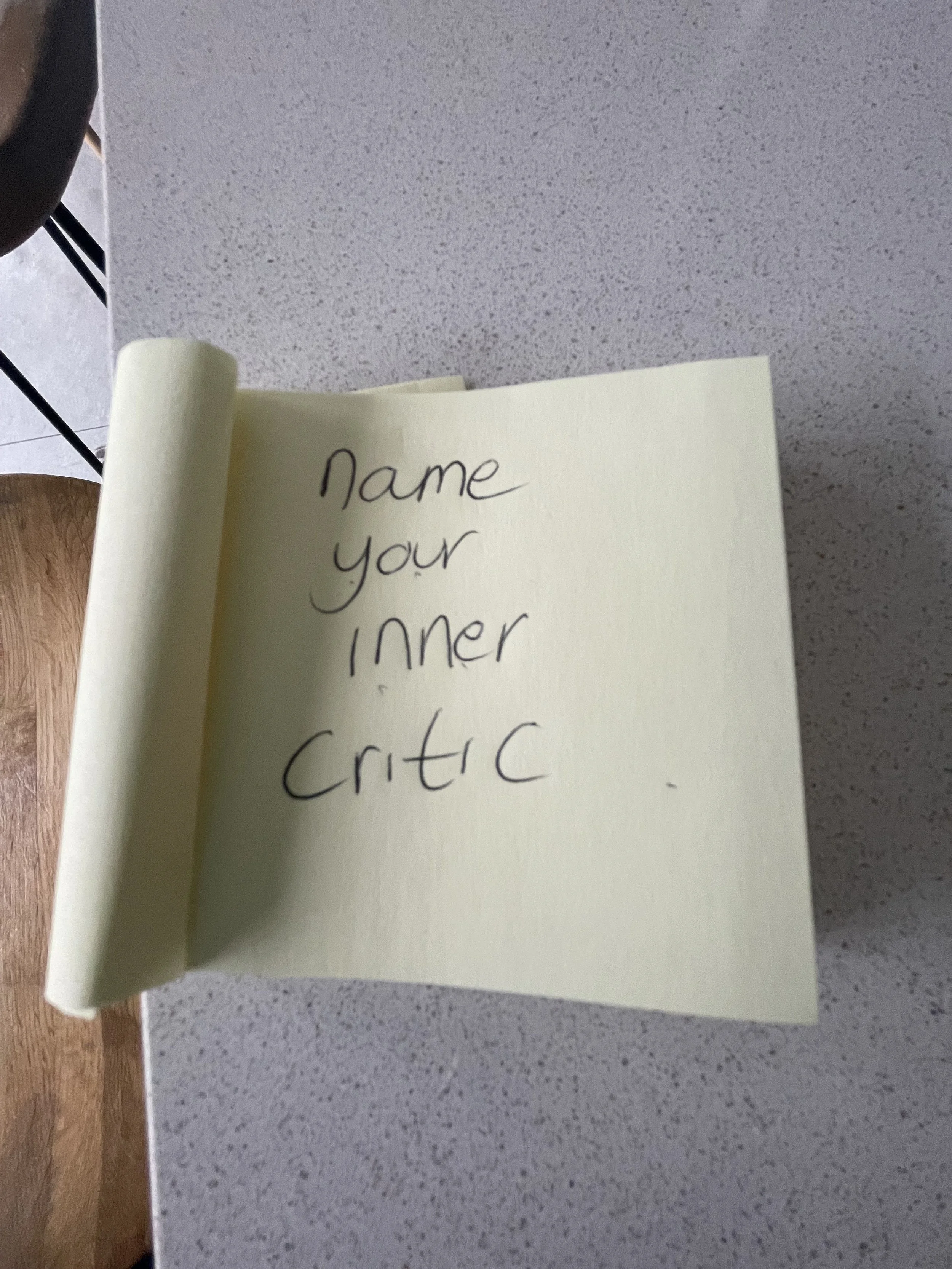
2. Bring understanding, curiosity and get playful.
Understand where the inner critic comes from. The critical voice often comes from our conditioning and life experiences, it believes that it is protecting you and trying to keep you safe. Often the critical voice can be the voice of someone in your life.
A voice from your younger life. It could be a teacher or a parent.Its purpose is to protect us and keep us safe when we were going through difficulty in life. You most likely grew up believing that if you listened to the critical voice it would motivate you into action. That you were required to turn on yourself to get anything done.
Try to accept that it is a part of you and instead of trying to push it down, bring a curiosity and playfulness and friendliness to it. Give your inner critic a name and ask it some questions.
How do you feel you are protecting me?
Why do you say those things?
Why is your voice so harsh?
You don’t try to hate it because that resistance will make it persist and be louder than ever.
This creates space and helps you to realise that it is a part of you but not all of you.
Try saying to your inner critic. ‘I hear you self-critical voice, i know you’re trying to help me do better but this isn’t helpful’.
3. Respond to the self-critical voice with self-kindness practices.
Many people struggle with the word Self-Compassion because it sounds soft and quite “woo”. It feels self-indulgent and weak, and that it will make them lazy and demotivate them.
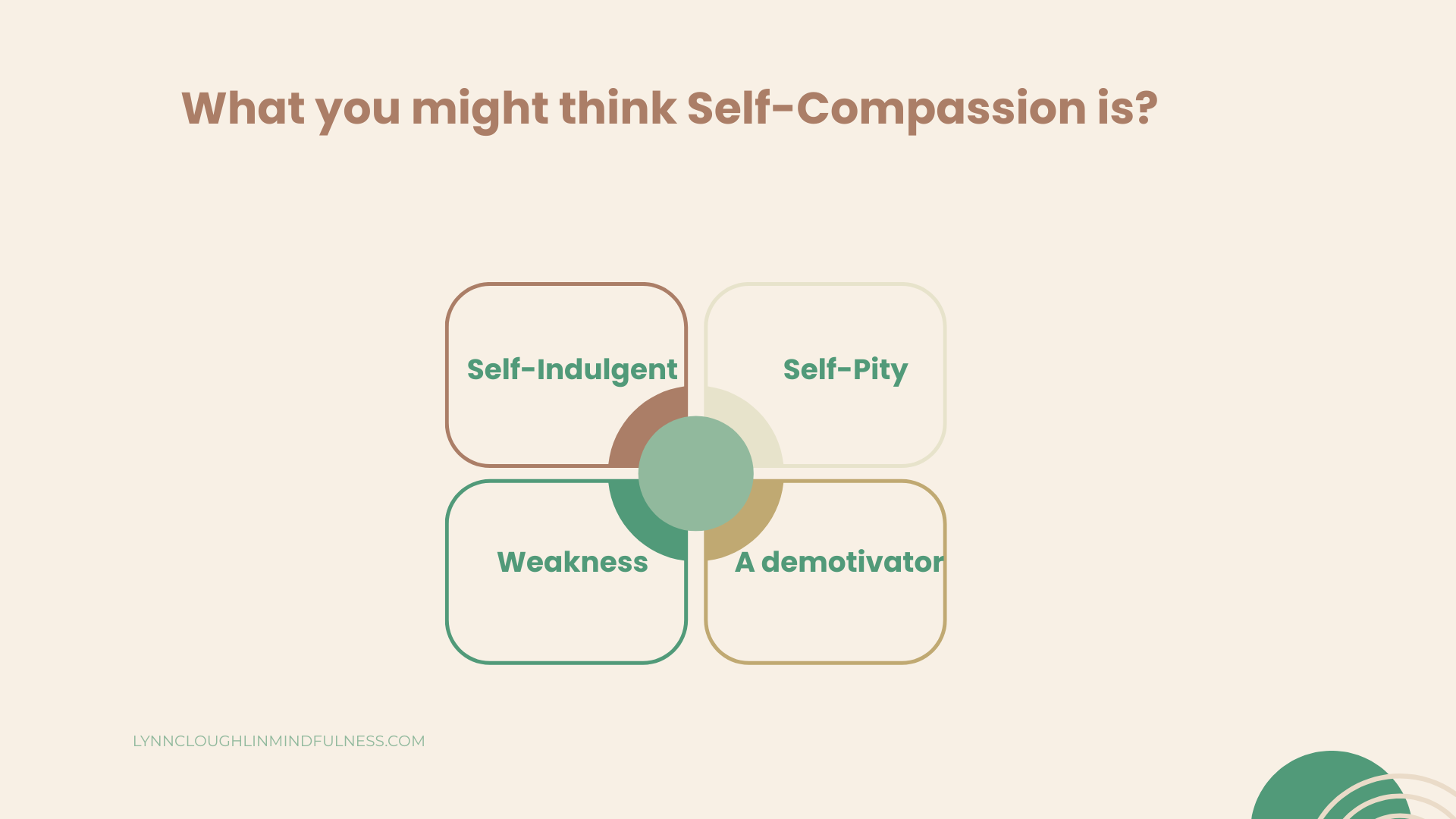
The research says otherwise. Self-compassion studies show that practicing self-compassion is in fact a motivator. It reduces stress and anxiety and helps us cope better.
Self-Compassion can be defined as when kindness meets suffering. We also often hear it described as talking to yourself the way that you would to a dear friend. It really is so much more than repeating kind phrases to yourself. I learnt this in my own life when I was struggling to support an anxious child.
It is to stop pushing through and to take what you need.
From this, I grew a self-compassionate inner voice that became an anchor, reminding me that everything is going to be okay.
How to grow this self-compassionate voice?
It is by asking yourself some key questions and then taking small actions that will help support your nervous system. Mindfulness in action is noticing first and then following it up with a kind action.
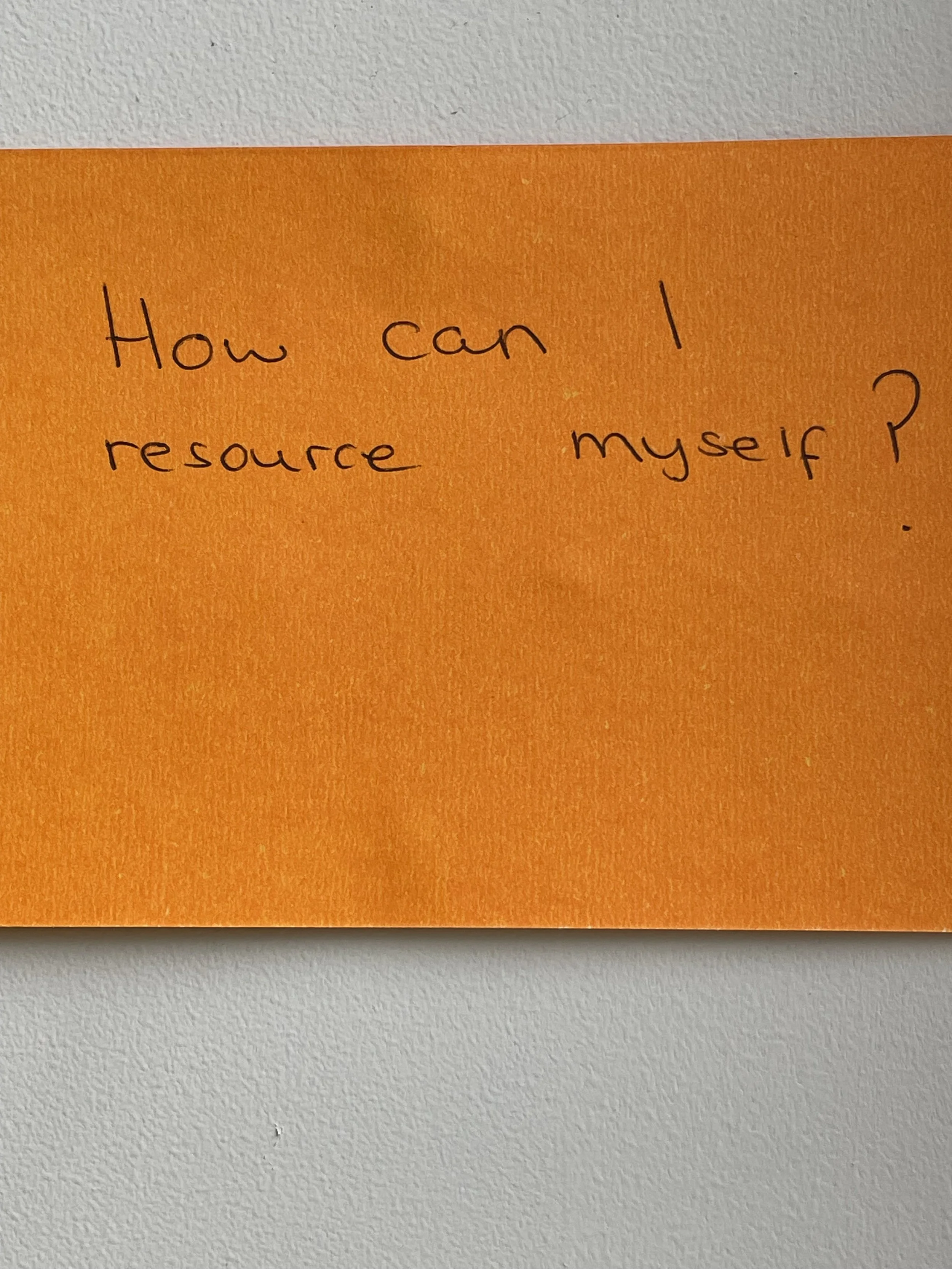
Here are some questions I use:
Is this helping or harming me?
What will help me get through this day?
How can I resource myself?
How can I be a kind friend to myself in this moment?
Am I turning on myself in this moment?
Each day, meet yourself wherever you are at. Do something that will support you, say no or put in place a boundary. Trust what you feel you are able to do and leave down what you can’t.
On days that feel very heavy, wrapping yourself up in your favourite blanket may be the kindest thing that you could do for yourself.
Leave down the expectations to be at a certain place. When you are struggling as a parent and going through periods of grief in your life, it’s important to remember that it is all going to take time. It can be easier said than done but if you try to accept that this is a season in your life where you need more kindness not less it will help bring ease.
When you let that self-compassionate voice in rather than beating yourself up that you are not feeling or thinking differently you will begin to believe that how you are at this moment in time is ok.
So once you have brought your self-critical voice into full view, understood that it is trying to protect you, have brought curiosity and opened the door to the self-compassionate voice, you have now done the ground work to move to using affirmations.
How to turn affirmations from empty words into something you truly believe in.
Affirmations can help provide emotional support and be used as a tool to grow a self-compassionate voice. To help the words feel like something that you truly believe, I recommend that you follow this checklist.
An affirmation checklist for daily practice.
Keep it simple. Affirmations can be big statements and feel very abstract and removed from real life. The language can make them feel harder to reach especially when you are a stressed and overwhelmed parent. Choose affirmations that have simple language. Words that speak directly to what you are experiencing. For example, I can handle today's challenges one step at a time.Use self-soothing touch. You can experiment with different ways such as using both hands over the heart, two hands over the centre of the heart or cradling your face in your hands.Choose some kind words such as, I am doing the best I can. Close your eyes and place two hands over your heart and repeat these words.
Make it visible. You can put it on a post it on your desk, at the front of your diary. You can put it anywhere you will see it regularly, even on your phone. I put mine on my bedroom mirror.
Start the day by saying it. Set an intention to say your affirmation when you first wake up. Setting up a consistent time in the day will support you to build a habit.
Use it to respond to the self-critical voice. When you hear the self-critical voice in your head. Acknowledge it but then call up the affirmation and turn up the volume on your words, I am doing the best I can.
Here are examples of some affirmations you can use
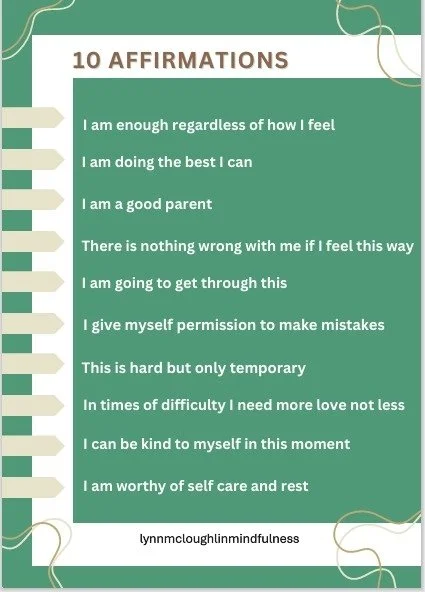
I invite you to set an intention to take one affirmation and apply the checklist. I’d love to hear your affirmation and if the steps help. Let me know in the comments.
P.S. Want to get more self-kindness practices? Come join my free mailing list! Weekly emails are sent every Friday. Join the list here
P.P.S. Grab How to Cope with Parenting Stress now, my FREE audio guide and discover the 5 minute practices to help stressed and overwhelmed parents truly cope. Grab the guide
If you would like to explore further how I can help you to cope as you parent when you are stressed and overwhelmed you can click the button below to book a free call and I will walk you through how I can support you individually. 👇

I’m Lynn McLoughlin a Mindfulness Coach.
I help parents feel calm, connected and confident. Moving them from being overwhelmed and stressed.
Enabling them to quieten down the self-criticism and judgement replacing it with a kinder inner dialogue.
Supporting them to create a life that feels centered and grounded.
Guiding them to cultivate more energy, rest, resilience and confidence to handle parenting challenges.